_
On This Page
Introduction
Imagine installing a normal software update on your Linux system.
Nothing looks suspicious.
There is no strange application, no obvious malware, and no warning telling you that something is wrong.
You are simply updating a piece of software that has been trusted and used for years.
Now imagine that the update itself contains a backdoor.
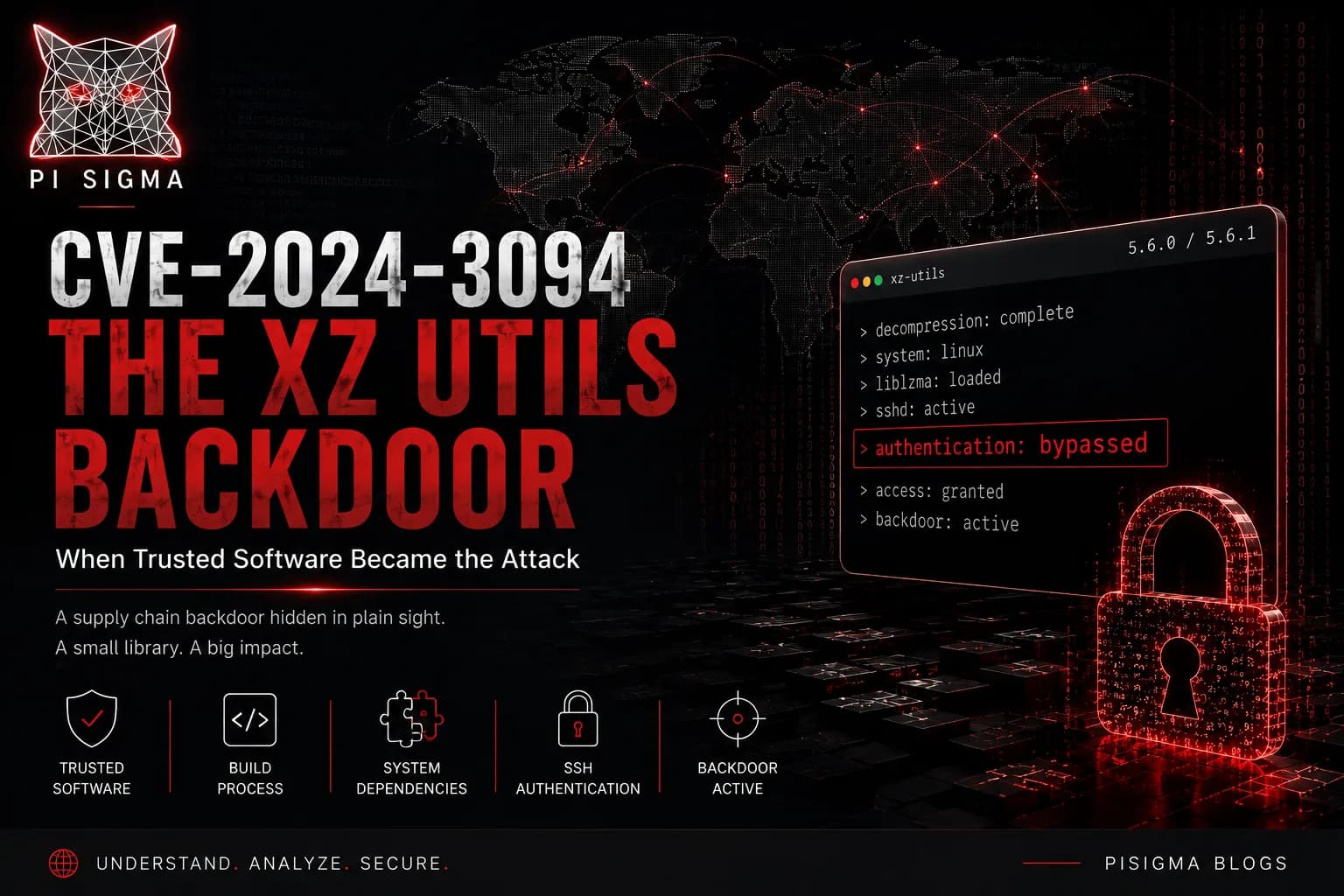
That is what made CVE-2024-3094, the XZ Utils backdoor, so unusual.
It wasn't just a case of an attacker finding a bug in a running application and exploiting it.
Instead, malicious code was deliberately introduced into a trusted open-source project and eventually made its way into software packages.
What makes the story even more interesting is that the compromised component was related to XZ Utils, a compression utility.
At first, that doesn't sound like something that should have anything to do with remote access or SSH.
But that connection is exactly what made this incident so serious.
First, What Is XZ Utils?
Before understanding the backdoor, it helps to understand what XZ Utils actually does.
XZ Utils is a collection of tools used for compressing and decompressing files.
Compression is pretty straightforward.
Suppose we have a large file:
Large file
    ↓
Compression
    ↓
Smaller file
The smaller file takes less space and can be easier to transfer or store.
XZ is commonly used in Linux environments, and many Linux distributions include it as part of their software ecosystem.
But XZ Utils isn't just a command-line tool.
It also provides libraries that other software can use.
One important library is:
liblzma
A simplified relationship looks like this:
XZ Utils
    │
    └── liblzma
           │
           └── Other software
And this is where things start getting interesting.
You don't necessarily need to run xz yourself for the library to matter.
Other components on the system may depend on it.
This Wasn't a Normal Vulnerability
When we hear the word CVE, we often imagine a familiar situation.
A developer writes vulnerable code.
A researcher discovers the problem.
An attacker finds a way to exploit it.
Something like:
Vulnerable software
       ↓
     Bug
       ↓
    Exploit
       ↓
    Attacker
CVE-2024-3094 was very different.
The problem wasn't simply that someone accidentally wrote a vulnerable function.
Malicious code had been deliberately introduced into the XZ Utils project.
The affected upstream versions were:
XZ Utils 5.6.0
XZ Utils 5.6.1
The result was a backdoor that could affect certain systems using these versions under specific conditions.
So instead of simply exploiting a bug that already existed, the attacker had attempted to create the vulnerability inside trusted software.
The Attack Started With Trust
One of the most interesting parts of the XZ incident is that it involved the software development process itself.
The attacker didn't need to immediately break into thousands of Linux servers.
Instead, the project itself became the target.
Through a long process of gaining trust and access within the XZ project, malicious changes were eventually introduced.
This is an important difference.
Instead of:
Attacker
   ↓
Victim's server
the attack looked more like:
Attacker
   ↓
Software project
   ↓
Build process
   ↓
Software package
   ↓
Linux systems
The attacker was trying to move through the software supply chain.
And that is what makes this incident particularly important from a security perspective.
The Backdoor Wasn't Sitting in Plain Sight
One of the reasons the attack was difficult to identify was the way the malicious code was introduced.
It wasn't simply a clearly named function such as:
backdoor()
waiting inside the source code.
Instead, malicious components were hidden within parts of the project and its build process.
Some of the suspicious components appeared to be related to testing or build operations.
During the build process, these components could be used to introduce malicious code into the resulting library.
A simplified view is:
Source files
     +
Build scripts
     +
Hidden malicious components
     ↓
Build process
     ↓
Modified liblzma
This creates an important security lesson:
The source code you read and the software you eventually execute are not always the same thing.
The build process itself can become an attack surface.
But Why Does SSH Come Into This?
This is probably the most surprising part of the entire story.
XZ Utils is associated with compression.
SSH is associated with remote access.
So what connects the two?
The answer involves dependencies and system components.
On affected Linux systems, the compromised liblzma could become involved in the environment used by the SSH server.
A simplified representation is:
XZ Utils
    ↓
  liblzma
    ↓
System components
    ↓
   sshd
    ↓
SSH authentication
The attacker wasn't simply modifying the SSH server directly.
Instead, the compromised library could interfere with the process in which the SSH service operated.
This is why understanding dependencies is so important in cybersecurity.
A component that looks harmless by itself can become extremely important when another critical service depends on it.
What Is SSH?
SSH, or Secure Shell, is one of the most widely used ways of remotely accessing Linux and Unix-like systems.
For example:
ssh user@server
This allows an administrator to connect to a remote machine and manage it.
Servers exposed to the Internet commonly use SSH for administration.
So SSH is not just another application.
It is often a doorway into a server.
Normally, that doorway is protected by authentication.
Client
   ↓
SSH connection
   ↓
Authentication
   ↓
Authorized user
   ↓
Shell
The XZ backdoor was dangerous because it was designed to interfere with this authentication process under specific conditions.
What Could the Backdoor Do?
The malicious code could modify the behavior of the SSH authentication process on affected systems.
Under the necessary conditions, an attacker with the required secret/key material could cause commands to be executed on the target system without going through the normal authentication flow.
A simplified representation is:
Attacker
    ↓
SSH connection
    ↓
Affected server
    ↓
Backdoor
    ↓
Authentication process
    ↓
Potential command execution
This is why the vulnerability received a critical severity rating.
However, there is an important detail that is sometimes lost when people talk about this incident:
Not every Linux system with XZ installed was automatically vulnerable.
The attack depended on specific versions, build conditions, architecture, and runtime circumstances.
So saying:
"If you had XZ installed, attackers could immediately log into your machine."
would be misleading.
The actual situation was much more specific.
The Version Numbers Matter
The malicious backdoor was associated with:
5.6.0
5.6.1
These versions were released shortly before the issue was discovered.
This is one reason software version management is so important.
A tiny version change can sometimes introduce a significant security problem.
It also demonstrates why security teams shouldn't treat software updates as simply:
"Newer version = automatically safer."
Updates are important, but understanding what changed can be equally important.
Then Something Didn't Look Right
The backdoor might have remained hidden for much longer if everything had behaved perfectly.
But something didn't.
A developer named Andres Freund noticed unusual behavior while investigating performance issues involving SSH.
There was unexpected CPU usage and a strange performance difference during SSH operations.
At first, this might sound like an ordinary performance problem.
But instead of ignoring it, he investigated.
The investigation eventually led toward liblzma.
And that investigation uncovered something much bigger.
Unusual behavior
       ↓
Performance investigation
       ↓
Suspicious liblzma behavior
       ↓
Further analysis
       ↓
Hidden malicious code
       ↓
XZ backdoor
A small anomaly had helped expose a potentially enormous security problem.
That part of the story is particularly interesting because it shows that security discoveries don't always begin with someone actively hunting for a vulnerability.
Sometimes they begin with:
"Why is this behaving differently?"
The Supply Chain Was the Real Attack Surface
CVE-2024-3094 is often described as an XZ backdoor.
But there is a bigger concept behind it:
Software supply-chain security.
Modern software rarely exists by itself.
A typical application might depend on dozens, hundreds, or even thousands of other components.
For example:
Application
    ↓
Library A
    ↓
Library B
    ↓
Library C
    ↓
Operating system
If one of those components becomes compromised, the impact can travel through the dependency chain.
The XZ incident demonstrated this problem very clearly.
The malicious code wasn't delivered to victims as an obviously malicious program.
It was introduced into software that was expected to be trusted.
Trust Can Become an Attack Surface
This is probably one of the biggest lessons from the incident.
Security isn't only about protecting servers, applications, and networks.
We also need to think about who and what we trust.
Consider the chain:
Developer
    ↓
Open-source project
    ↓
Maintainer
    ↓
Build system
    ↓
Package
    ↓
Linux distribution
    ↓
Your server
Every step involves some level of trust.
If an attacker manages to compromise one important step, the consequences can reach much further down the chain.
That's what makes supply-chain attacks so interesting.
The victim may do everything that appears normal.
They install legitimate software.
They use official repositories.
They keep their systems updated.
And yet the software itself may have been compromised before it reached them.
Why Was It So Difficult to Notice?
The attack was designed to avoid attracting attention.
The malicious code was heavily obfuscated and hidden through a complicated combination of project files and build behavior.
That meant that simply opening the main source files and looking for something suspicious wasn't necessarily enough.
The attack relied on several layers:
Project
   ↓
Source files
   ↓
Build process
   ↓
Generated code
   ↓
Modified library
   ↓
Runtime behavior
Each layer made the overall picture harder to understand.
This is an important lesson for security researchers:
Don't always stop at the code you can immediately see.
Sometimes the interesting behavior happens during compilation, packaging, loading, or execution.
What Made CVE-2024-3094 Different?
There are many vulnerabilities where the attacker discovers a mistake in someone else's code.
XZ was different because the attacker appeared to be working toward controlling part of the software development process itself.
The goal wasn't simply:
Find bug → Exploit bug
It was closer to:
Gain trust
    ↓
Gain project access
    ↓
Introduce malicious changes
    ↓
Hide the changes
    ↓
Build compromised software
    ↓
Distribute it
    ↓
Reach critical systems
That is a very different security problem.
It moves the focus from:
"Is this application vulnerable?"
to:
"Can I trust how this software was produced?"
What I Found Most Interesting While Learning About It
The biggest thing that stood out to me while learning about CVE-2024-3094 is that the attack didn't begin with an obviously vulnerable server.
It began much earlier.
It involved people, trust, source code, maintainers, build systems, dependencies, packages, and finally the systems running that software.
The vulnerability was only one part of the story.
The bigger picture looked something like this:
People
  ↓
Project
  ↓
Code
  ↓
Build
  ↓
Package
  ↓
Dependency
  ↓
System
  ↓
SSH
Every step mattered.
And that is what makes supply-chain security so challenging.
What This Teaches Us About Open-Source Software
The XZ incident shouldn't be interpreted as:
"Open-source software is unsafe."
That's not the lesson.
Open-source software is used everywhere and provides enormous value.
The lesson is that open-source projects also need strong security practices.
Things such as:
- Maintainer access controls
- Code review
- Reproducible builds
- Build-system security
- Package verification
- Dependency monitoring
- Release monitoring
- Anomaly detection
all matter.
Having source code available for inspection is valuable, but it doesn't automatically make the entire software supply chain secure.
A Small Anomaly Can Matter
Another lesson that stood out to me is the importance of unexpected behavior.
The discovery wasn't simply:
"Someone decided to inspect every line of XZ."
A performance anomaly raised questions.
Those questions led to investigation.
The investigation led to deeper analysis.
And that eventually exposed the backdoor.
This is a useful mindset in cybersecurity.
When something behaves differently from what you expect, don't immediately assume it's harmless.
Ask:
Why did this change?
What component is responsible?
What happens underneath?
Can I explain the behavior?
Sometimes the smallest clue can lead to the biggest discovery.
The Bigger Security Lesson
CVE-2024-3094 changed the way I look at software dependencies.
Before learning about incidents like this, it is easy to think of a dependency as simply:
"Some library my application needs."
But dependencies can sit deep inside the technology stack.
A library that looks unrelated to security can eventually become part of a security-critical process.
The chain can look like:
Small library
     ↓
System dependency
     ↓
Critical service
     ↓
Authentication
     ↓
Remote access
That is why security researchers need to understand not just individual vulnerabilities, but also how software is connected.
Final Takeaway
CVE-2024-3094 is remembered as the XZ Utils backdoor, but the most interesting part of the incident isn't just the malicious code.
It's the path that code took.
A trusted open-source project.
A carefully developed level of trust.
Malicious changes hidden within the build process.
A commonly used library.
A connection to a critical system service.
A potential impact on SSH authentication.
And finally, a small performance anomaly that helped uncover the entire problem.
For me, the biggest lesson is simple:
Security isn't only about finding bugs in the software you use.
Sometimes you have to ask a much earlier question:
"Can I trust the software before I even run it?"
Because in modern software, the attack surface doesn't always begin at your server.
Sometimes, it begins in the supply chain.
This article is intended for educational purposes and security research in authorized environments.